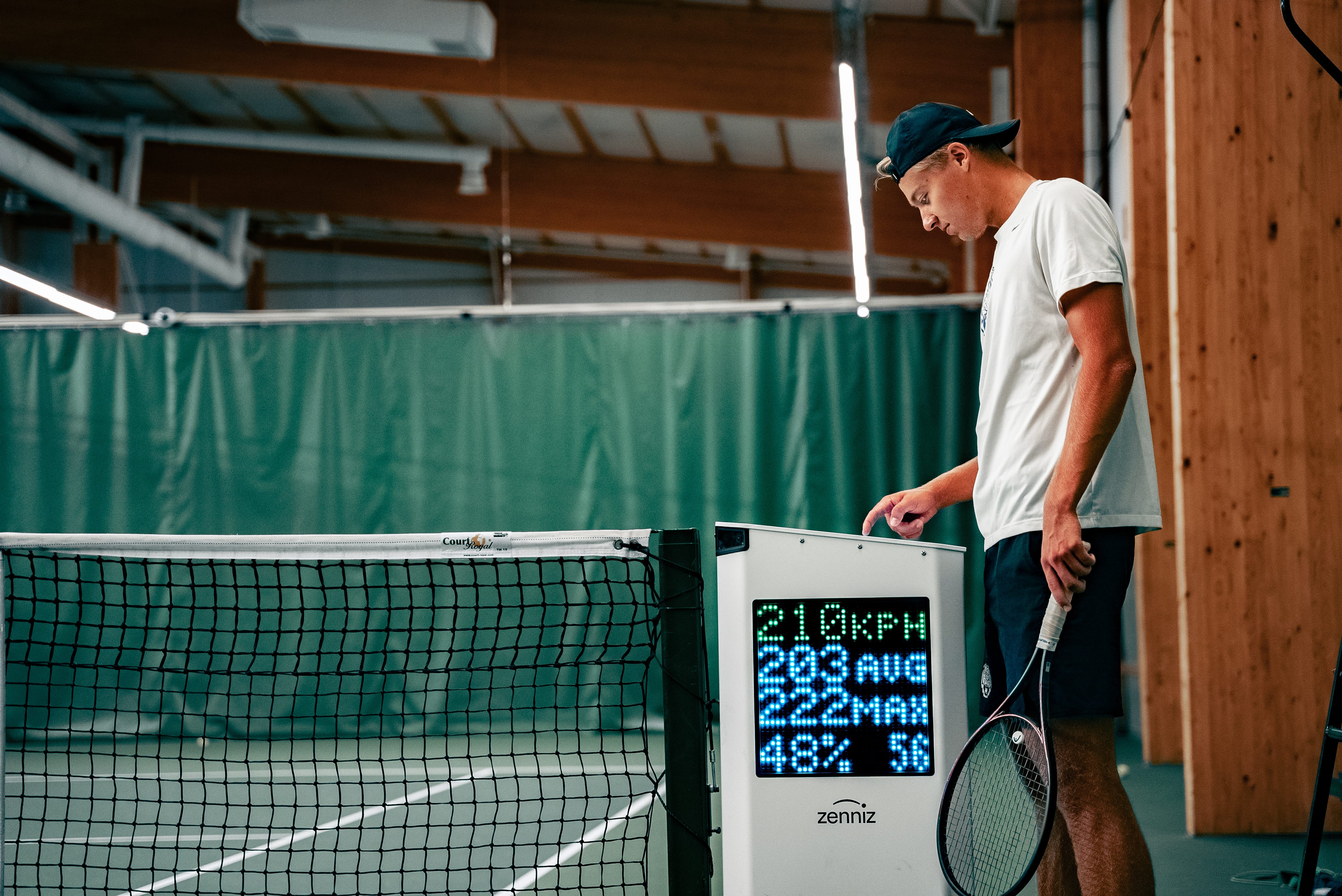
Manual charting in tennis is being rapidly superseded by court technology that delivers automated, professional-grade analytics with zero effort from the player. By replacing subjective observation and tedious note-taking with integrated tracking systems, coaches and enthusiasts gain immediate access to precise statistics for tennis—including shot placement, speed, and consistency rates—transforming raw data into actionable insights for faster improvement and smarter match play.
Tennis is a sport of split-second decisions and margins measured in millimeters. For generations, players and coaches have relied on memory, intuition, or the diligent scribbling of a parent or assistant on the sidelines to understand what went right or wrong during a match. While this dedication to improvement is admirable, the human eye simply cannot capture the velocity and volume of data that a modern match produces. The reliance on clipboards and tally marks is a tradition that has served its purpose, but it is now making room for a more precise, effortless approach to game analysis.
We believe that every player, regardless of their ranking, deserves the clarity that comes from objective data. Relying on handwritten notes often results in incomplete information or subjective bias—missing the nuances of why a match was won or lost. By automating this process, we unlock a new level of understanding where statistics for tennis become a tool for empowerment rather than a chore. This technological evolution allows coaches to return their focus to strategy and human connection, while systems handle the heavy lifting of tracking every ball, spin, and landing spot with unwavering accuracy. It is time to elevate the training environment and embrace a method that is smarter, fairer, and infinitely more engaging.
The Limits of Human Observation in a High-Speed Game
Even the most experienced coaches and dedicated parents face a biological limitation when analyzing a tennis match: the sheer speed of play. Modern tennis is dynamic and explosive, with ball speeds often exceeding the capacity of the human eye to track accurately in real-time. When a serve lands on the T or a forehand clips the baseline, our brains often fill in the gaps based on expectation rather than reality. This is where manual charting falls short—it attempts to freeze a fluid, high-velocity sport into static marks on a page, often missing the subtle nuances that define the difference between winning and losing.
The "Highlight Reel" Bias
One of the most significant challenges with manual observation is our natural tendency toward confirmation bias. We are hardwired to remember the emotional peaks of a match—the blistering ace on break point or the spectacular passing shot that ended a long rally. However, statistics for tennis reveal that matches are often decided by the "boring" points: the consistent depth of a cross-court rally or the percentage of second serves returned safely.
When relying solely on memory or simple tally marks, players often overestimate their aggressive plays and underestimate their unforced errors. This skewed perception can lead to training plans that focus on the wrong areas, such as practicing winners when the data shows the real issue is consistency.
What the Clipboard Misses
Beyond the mental bias, the physical act of charting a match manually forces a difficult trade-off. If a coach is looking down to record a shot, they are momentarily not looking at the player. This split attention means missing valuable biomechanical details or tactical shifts. Furthermore, there are critical metrics that simply cannot be captured by pen and paper, no matter how fast one writes:
Precise Ball Placement: Distinguishing whether a ball landed near the service line or deep in the court requires tracking technology, not just a judgment call.
Net Clearance: Understanding the shape of the shot and the margin for error is impossible to quantify manually.
True Velocity: Estimating speed is vastly different from knowing the exact mph/kph of a serve or groundstroke.
By delegating the data collection to a system, we remove the burden of recording from the observer. This allows the coach to return to their primary role: observing the player's psychology, movement, and strategy, secure in the knowledge that the objective data is being captured perfectly in the background.
How Computer Vision Unlocks Data We Never Saw Before
The transition from manual charting to computer vision represents a fundamental shift in how we understand the game. Imagine a court that never blinks, capturing the trajectory of the ball and the movement of the players with millimeter precision, thirty times a second. This is the power of the Zenniz Court system. It moves beyond simple video recording to digitize the match in real-time, transforming physical action into a wealth of statistics for tennis that were previously impossible to calculate without a team of data scientists.
Seeing the "Invisible" Game
While a coach can tell you if a shot looked fast, computer vision quantifies exactly how fast it was. More importantly, it reveals the mechanics of consistency that the naked eye often misses. One of the most valuable insights unlocked by this technology is net clearance. A ball that skims the net cord and one that clears it by a safe margin may look similar when they land deep in the court, but the risk profile is entirely different. Computer vision tracks the height of the ball as it crosses the net, allowing players to understand their margin for error and adjust their aim to play with higher percentages.
From Guesswork to Heatmaps
Manual charting might tell you that you hit 20 forehand winners, but it rarely tells you where you were standing when you hit them or where they landed in relation to the sidelines. Computer vision aggregates this data into intuitive heatmaps, revealing patterns that define a player's style. Suddenly, abstract concepts become visual facts:
Shot Depth Analysis: Instantly see if your neutral rallies are landing short, inviting your opponent to attack.
Serve Distribution: Visualize whether you are predictable with your T-serves or if you are effectively using the full width of the box.
Impact Points: Understand where you are making contact with the ball—are you stepping in, or are you consistently being pushed behind the baseline?
Connecting Fitness to Performance
The data extends beyond the ball itself to the athlete's physical exertion. By tracking player movement, we can correlate fatigue with performance. We can answer critical questions: Does your serve speed drop after running a certain distance? Do your unforced errors spike after long rallies? This level of insight bridges the gap between technical tennis training and physical conditioning, ensuring that players are not just hitting the ball better, but are physically prepared to maintain that level throughout a grueling match. It turns the court into a laboratory for improvement, accessible to anyone ready to play.
Balancing Algorithmic Precision with Coaching Intuition
There is often a misconception that the introduction of advanced technology threatens the role of the coach, as if algorithms could replace the wisdom earned through years of court-side experience. At Zenniz, we see it differently. We believe that technology should not replace the coach; it should liberate them. By automating the objective side of the game—the lines, the counts, the physics—we free the coach to focus entirely on the subjective, human elements that truly drive player development.
Data without context is just noise. While our Courts can generate comprehensive statistics for tennis match play, they cannot measure a player's confidence, their mental resilience on a break point, or the subtle biomechanical flaw causing a drop in serve percentage. This is where the coach’s intuition remains irreplaceable. The machine provides the "what"—the cold, hard facts of the match—while the coach provides the "why" and the "how." It is a partnership where technology handles the heavy lifting of observation, allowing the human expert to handle the art of interpretation.
Validating the "Gut Feeling"
Every experienced coach has had moments where they know a player is struggling with a specific shot, but the player remains unconvinced. Subjective feedback can sometimes feel like personal criticism, leading to defensive reactions. In these moments, data acts as an impartial mediator. When a coach can point to a screen and show that 70% of unforced errors are landing in the net rather than going long, the conversation shifts from opinion to fact.
This validation strengthens the bond between player and coach. Instead of debating the problem, they can immediately collaborate on the solution. The coach’s "gut feeling" is no longer a guess; it is an insight supported by evidence. This objective feedback loop accelerates trust, as players can clearly see that the training plan is based on the reality of their performance rather than just observation.
The Human Element of Strategy
While an algorithm can highlight a pattern—such as a player consistently hitting short when under pressure—it takes a coach to understand the root cause. Is it a footwork issue? Is it a grip change? or is it simply nerves? A Court delivers the diagnosis, but the coach prescribes the cure. The most effective use of modern analytics involves blending these two worlds:
Emotional Context: A computer might flag a drop in performance in the third set, but a coach knows if it was due to physical fatigue or a loss of focus.
Tactical Adjustments: Data can show where the opponent is hitting the ball, but the coach teaches the player how to anticipate those shots based on body language.
Personalized Communication: Some players respond to raw numbers; others need visual heatmaps or simple verbal cues. The coach translates the data into the language the player understands best.
Ultimately, the goal is to create a training environment where precision meets empathy. By entrusting the tracking to Zenniz, coaches can spend less time marking clipboards and more time making eye contact, correcting form, and inspiring their players to reach the next level.
Democratizing Analytics for Junior and Club Players
For decades, a massive divide has existed in the world of tennis. On one side, we have the professional tour, where every bounce is tracked, every line call is electronically verified, and post-match analytics are discussed in microscopic detail. On the other side is the rest of the tennis world—millions of passionate juniors and club players who play for the love of the game but are left guessing about their performance. At Zenniz, we believe this divide should not exist. Access to professional-grade technology shouldn't be reserved for the top 100 players in the world; it should be available to anyone who picks up a racquet.
By bringing court infrastructure to local clubs, we are effectively leveling the playing field. This "democratization" of data means that a Tuesday night league match or a Saturday morning junior coaching session can benefit from the same insights used at Grand Slams. It transforms the court from a simple slab of concrete or clay into an interactive hub that supports player development at every stage of the journey.
The End of the "Bad Call"
One of the most immediate and tangible benefits of bringing this technology to the club level is the introduction of automatic line calling. We have all experienced the frustration of a disputed call—the uncertainty that can sour a friendly match or distract a junior player during a crucial tournament tie. By removing the guesswork, we remove the conflict.
When players trust the court, they play with more freedom. They stop worrying about the opponent's eyesight and start focusing on their own shots. This creates a fairer, more enjoyable environment where the spirit of the game is preserved, and the result is decided purely by skill. It’s about bringing integrity to every point, ensuring that the only drama on the court is the tennis itself.
Visual Learning for a Digital Generation
For junior players, in particular, the integration of video and statistics for tennis is a natural fit for how they learn. The next generation of talent is accustomed to instant feedback and visual data. Telling a young player they need to "step in" is helpful, but showing them a video clip of their last five short balls, paired with a heat map of their impact points, is transformative.
Zenniz facilitates this by automatically syncing the data to video. Players can walk off the court and immediately watch a playlist of their winners or analyze their serve technique from multiple angles. This accelerates the learning curve significantly:
Instant Validation: Juniors can see exactly what they did right, reinforcing good habits immediately after a session.
Engagement: Gamified stats and leaderboards make practice fun, encouraging players to spend more time on court.
Ownership: Players take charge of their own development, logging into the app to review their progress over time.
By making these tools accessible, we aren't just training better tennis players; we are fostering a deeper connection to the sport. Whether you are a club player looking to finally beat your rival or a junior dreaming of a college scholarship, the technology is now here to support your ambition.