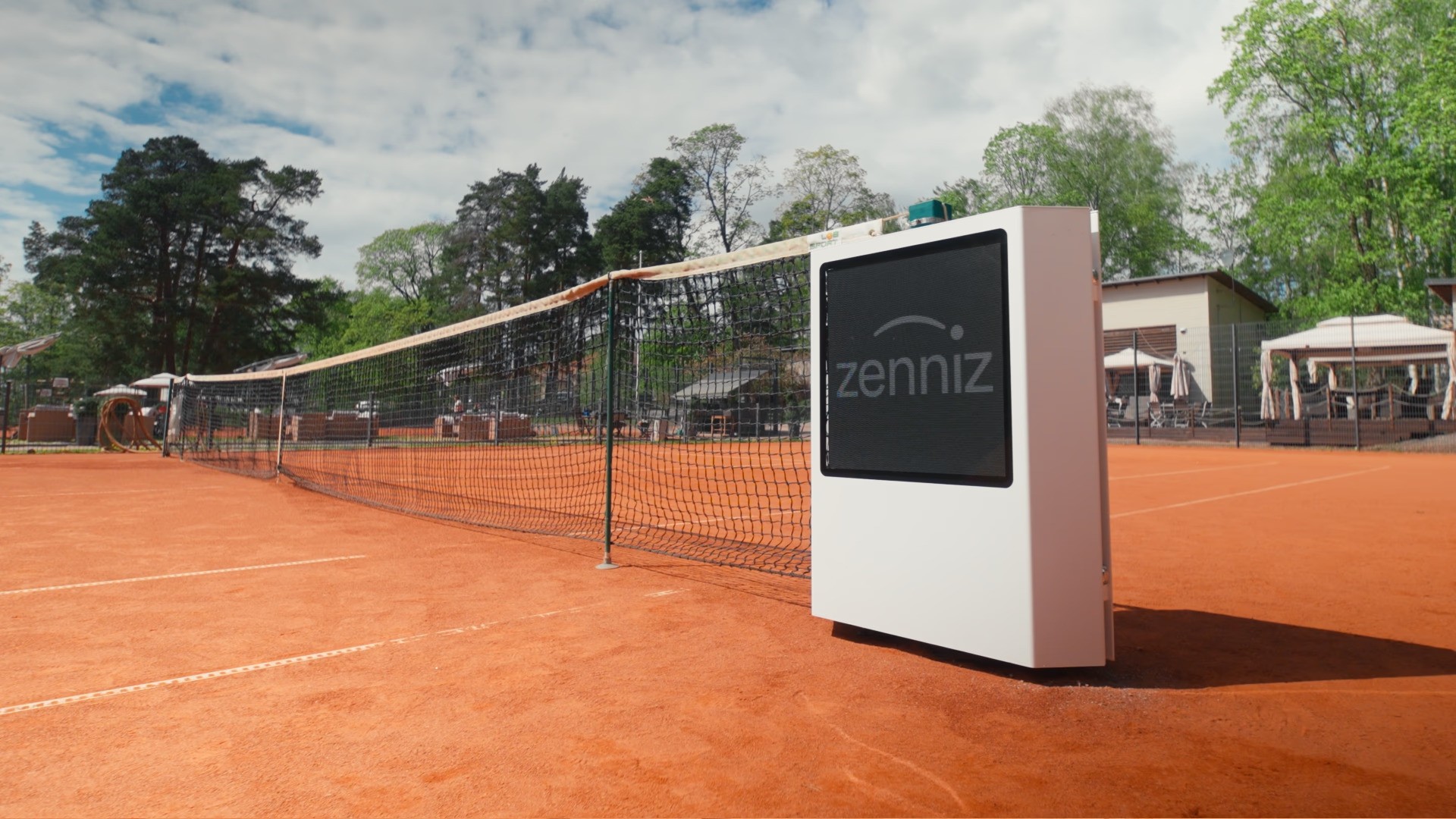
Automated tennis recording systems revolutionize player development by removing the friction of manual camera setups and providing instant, high-definition visual feedback. By integrating video capture directly into the court infrastructure, players and coaches can immediately analyze biomechanics and tactical patterns, effectively bridging the gap between perceived performance and actual execution for faster, data-driven improvement.
Tennis is a sport defined by precise biomechanics and split-second decisions. Often, the greatest obstacle to improvement is the disconnect between what a player feels they are doing and what is actually happening on the court. You might be convinced your racquet preparation was early enough or that your stance was open, but the result often suggests otherwise. This gap between "feel" and "real" is where consistent tennis recording becomes an indispensable tool for growth.
For a long time, accessing this level of visual feedback required a significant logistical effort. Players had to fiddle with tripods, manage limited smartphone storage, and interrupt their rhythm to check angles. This friction often meant that video analysis was reserved for special occasions rather than becoming a habit. However, the emergence of the court is changing this narrative entirely. We are entering an era where technology works silently in the background, allowing you to focus entirely on the ball while the system captures every rally, serve, and volley automatically.
Embracing automated video technology does more than just archive your matches; it democratizes professional-grade analysis. Whether you are a club player looking to fix a backhand or a coach managing high-performance juniors, having immediate access to synchronized video allows for objective assessment. It transforms the court into a learning environment where feedback is based on evidence, not just intuition, helping you elevate your game with clarity and confidence.
Bridging the Gap Between Feel and Real Mechanics
There is a phenomenon known to almost every tennis player, from the weekend warrior to the touring pro: the sensation of a stroke rarely matches the biomechanical reality. You may feel like you are stepping into the court and driving through the ball, yet the footage reveals you are leaning back and arming the shot. This disconnect creates a barrier to improvement that verbal feedback alone struggles to dismantle. High-quality tennis recording acts as the ultimate truth-teller, providing the objective evidence needed to align your perception with your performance.
The Power of Visual Confirmation
We process visual information significantly faster than auditory instructions. A coach can tell you to "shorten your backswing" repeatedly, but until you see the racquet lagging behind your body on a screen, the advice often remains abstract. Visual evidence converts a theoretical concept into a tangible reality. By reviewing footage immediately after a set or a drill, you can create a direct mental link between what you just felt and what actually happened. This accelerates the learning curve, turning weeks of trial and error into moments of instant clarity.
Identifying Hidden Technical Leaks
High-definition recording on a Court captures details that the human eye might miss in real-time. Subtle technical flaws often hide in the transition phases of a shot. Without video, these "leaks" in power and accuracy can remain undiagnosed for years. When you slow down the footage, you can isolate specific mechanical elements that define the quality of your game:
Preparation Timing: Are you preparing as early as you think, or does the video show the racquet still moving back as the ball bounces?
Contact Point Consistency: Verifying if you are meeting the ball out in front or letting it travel too deep into your stance.
Recovery Patterns: Observing your movement immediately after the shot to ensure you are resetting to the optimal court position.
Spotting these nuances allows you to adjust your training focus with precision. Instead of vague goals like "hit better forehands," you can target specific biomechanical adjustments, making your practice sessions smarter, fairer, and more efficient.
Validating Progress and Building Confidence
Recording is not solely about error correction; it is equally vital for recognizing success. Improvement in tennis is often gradual, making it difficult to notice day-to-day changes. Maintaining a video archive allows you to look back at your form from three or six months ago and see the tangible evolution of your game. Seeing your serve technique stabilize or your footwork become more explosive provides a massive psychological boost. It validates the hard work you put in on the court and reinforces the belief that you are on the right path.
Spotting Tactical Habits You Miss in the Heat of Battle
When you are deep in a third set, with your heart rate climbing and the pressure mounting, your brain often shifts into survival mode. In this state, "tunnel vision" takes over, and your awareness of the broader court geometry shrinks down to just the ball and the opponent. It is incredibly difficult to analyze your own tactical patterns while you are busy executing them. This is where automated tennis recording transforms from a technical tool into a strategic weapon. By stepping back and reviewing the match footage dispassionately, you can see the game as it actually unfolded, not just how it felt in the moment.
Decoding Your Shot Selection Patterns
Every player has subconscious tendencies, especially under pressure. You might be convinced that you were mixing up your play, but the video evidence often reveals a different story. Perhaps you instinctively hit to your opponent’s strong forehand whenever you are pushed wide, or maybe you overuse the slice when a topspin drive would open up the court. Video analysis exposes these repetitive loops. Once you identify that you are becoming predictable in specific situations, you can consciously work to disrupt those patterns in your next practice session. It turns the abstract concept of "playing smarter" into a concrete plan of action.
The Truth About Court Positioning
Positioning is arguably the most critical aspect of tactical tennis, yet it is the hardest to self-correct without visual aid. A common issue for club players and developing juniors is the "false recovery." You might feel like you are recovering to the center of the court after a shot, but the camera often shows you lingering two steps too far to the left, leaving the entire ad court wide open. Proprietary tracking technology and intelligent cameras provide a bird's-eye view of your movement, showing you exactly where you were standing versus where you should have been.
Reviewing your positioning allows you to understand the geometry of the point. You can ask yourself critical questions based on the footage:
Defensive Depth: Were you standing far enough back to handle their heavy topspin, or were you caught on your heels at the baseline?
Offensive Transition: When you hit that short ball, did you move forward to close the net, or did you retreat back to safety?
Serve Recovery: After landing your serve, did you split-step in a balanced position ready for the return?
Analyzing Momentum Shifts
A tennis match is a story of momentum, often decided by a few critical points. Tennis recording allows you to isolate these high-leverage moments—break points, tie-breaks, and set points—to see how your decision-making holds up under stress. Did you play to win, or did you play not to lose? Understanding your psychological and tactical response to pressure is the first step in mastering the mental game. By watching these moments back, you normalize the situation, making it less daunting the next time you face a break point in a real match.
The Risk of Over-Analysis and Tech Dependency
With the advent of accessible courts and detailed analytics, players today have access to a volume of data that previous generations could only dream of. However, there is a fine line between being informed and being overwhelmed. While tennis recording provides the objective truth needed to improve, consuming too much information at once can lead to "paralysis by analysis." It is crucial to remember that technology is a tool to support your natural game, not a replacement for your instincts. The goal is to enter a match with a clear mind, not a head full of mechanical checkpoints.
Finding the Balance Between Data and Flow
Tennis is a sport of rhythm and flow. When you are playing your best, you are likely not thinking about the degree of your knee bend or the exact millisecond of your split step; you are simply reacting. One of the potential pitfalls of heavy video usage is trying to consciously control every micro-movement during a match. This can result in stiff, robotic play where the fluidity of the stroke is lost to mechanical perfectionism.
The most effective way to use video is to separate the "analyst mode" from the "player mode." Use your recording sessions off the court to diagnose issues and set one or two clear intentions for your next practice. Once you step onto the court, trust the work you have done and let your muscle memory take over. The video is there to review what happened, not to dictate every movement in real-time.
Focusing on Trends, Not Anomalies
When you have hours of footage available, it is tempting to obsess over every single unforced error or missed opportunity. However, not every mistake requires a correction. Sometimes, a missed forehand is just a missed forehand—a result of a bad bounce or a momentary lapse in concentration, not a fundamental technical flaw. Hyper-focusing on isolated errors can lead to tinkering with strokes that are actually fundamentally sound, which can do more harm than good.
To keep your relationship with technology healthy and productive, focus on the macro trends rather than the micro incidents:
Recurring Patterns: Look for mistakes that happen three or four times in a similar situation (e.g., missing returns into the net on break points).
Cluster Errors: specific periods in a match where your level drops, indicating a potential loss of focus or physical fatigue.
Positive Reinforcement: Spend as much time analyzing your winners as your errors to understand what makes your game successful.
The Human Element Remains King
Ultimately, data and video are there to serve the human experience, not to define it. A court can tell you that your serve percentage dropped, but it cannot fully quantify the pressure of the moment or the psychological battle with your opponent. Coaches play a vital role here, acting as the bridge between the raw data and the player. They help filter the noise, ensuring that the technology empowers you rather than burdens you. By using tennis recording as a compass rather than a rigid instruction manual, you ensure that you remain the master of your own game, playing with both intelligence and heart.
Using Data to Validate Your Development Path
Improvement in tennis is rarely a straight line. There are plateaus, setbacks, and moments where it feels like you are working harder than ever but seeing fewer results. In these phases of doubt, emotional bias can cloud your judgment. You might feel like your serve is getting worse because you double-faulted twice in a tie-break, even if your overall percentage has actually improved. This is where the objective nature of tennis recording and court analytics becomes your most reliable partner. By tracking specific metrics over time, you replace guesswork with hard evidence, ensuring your training plan is actually delivering the results you want.
Turning Subjective Feelings into Objective Facts
Every player has walked off the court feeling great about their game, only to see the scoreline suggest otherwise—or conversely, felt terrible despite winning comfortably. Our internal "feel" is often influenced by our most recent emotion or a single memorable shot. Data provides a stabilizing counter-narrative. When you integrate video with match statistics, you get a complete picture of your performance reality.
For example, you might feel your backhand is a liability. However, the data might show that while you hit fewer winners from that wing, your unforced error count is extremely low, making it a solid defensive foundation. Seeing this allows you to stop trying to "fix" a stroke that isn't broken and instead focus on capitalizing on its consistency. This clarity saves valuable practice time and prevents unnecessary tinkering.
Setting Measurable Benchmarks
To truly elevate your game, you need to move beyond vague goals like "get more consistent" to concrete, measurable targets. Automated tracking allows you to set benchmarks based on your own historical performance. These metrics serve as checkpoints on your development roadmap, giving you specific numbers to chase during your practice blocks.
Effective benchmarks to track might include:
First Serve Percentage: Aiming to maintain a consistent 60% or higher across five consecutive matches.
Rally Length: Tracking your ability to sustain rallies of 10+ shots without error during baseline drills.
Net Points Won: Monitoring your success rate when approaching the net to validate your transition game improvements.
Aligning Player and Coach Perspectives
One of the most common friction points in player development is a misalignment between what the coach sees and what the player believes. A coach might insist that a junior player is playing too passively, while the player feels they are being aggressive but just missing. Video and data bridge this communication gap instantly.
When both parties look at the same heat map showing ball impact points landing short of the service line, the debate ends. The conversation shifts from "I think you are hitting short" to "Here is the proof we are hitting short; let's fix it." This shared reality fosters a more collaborative and trusting relationship. It empowers the player to take ownership of their development, knowing that the feedback is based on indisputable facts, not just opinion. In this environment, the Court becomes a neutral arbiter that helps everyone pull in the same direction—towards a better game.