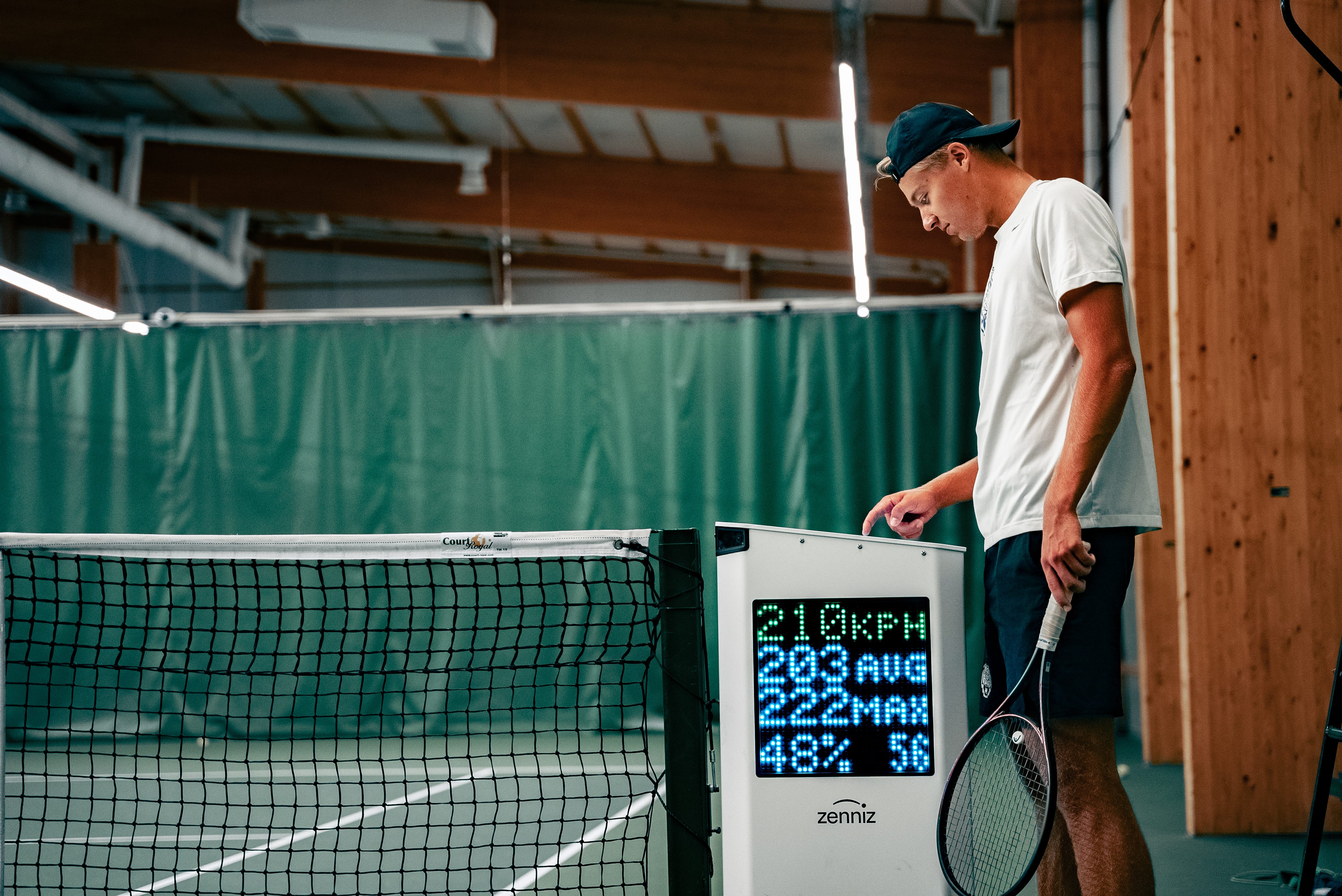
In high-level competitive play, the difference between victory and defeat often rests on a handful of strategic adjustments. Elite players use tennis data to move past surface-level stats like winners or aces, focusing instead on consistency metrics, shot depth, and ball placement. By ignoring the "noise" of flashy but low-percentage shots, professionals leverage real-time insights to maintain tactical dominance, ensuring their training is as precise as their performance on the court.
The Evolution of the Game: Moving Beyond Traditional Match Stats
Tennis is such a beautiful, and difficult, game. For decades, the sport relied on subjective observation and manual record-keeping. Coaches would sit in the stands with notebooks, frantically scribbling tallies for first serves and unforced errors. While this provided a general sense of a player's performance, it lacked the nuance required to truly dissect the mechanics of a win. This era of "gut feeling" coaching is rapidly being replaced by a more sophisticated, analytical approach.
Today, we find ourselves at the center of a technological revolution. The shift from manual charting to automated systems has democratized the kind of elite intelligence once reserved for those on the ATP and WTA tours. At Zenniz, we believe that every match deserves the fairness and clarity provided by modern innovation. The evolution of the game isn't just about faster rackets or more athletic players; it’s about the democratization of information. When we talk about tennis data, we are talking about a bridge that connects traditional effort with modern efficiency, turning every practice session into a laboratory for improvement.
Modern professionals no longer look at a stat sheet to see *if* they lost; they look at the data to understand *why*. Was it a lack of depth on the second serve return? Was the rally length consistently shorter than their optimal range? By moving beyond the box score, players can identify the structural integrity of their game, ensuring they stay smarter, fairer, and more engaging on the court.
Consistency Over Power: The Metric That Defines Elite Performance
It is a common misconception among hobbyists that power is the ultimate arbiter of success. While a 130-mph serve or a screaming cross-court forehand looks impressive on a highlight reel, elite players know that consistency is the true foundation of greatness. In the professional world, the most critical tennis data points often revolve around rally tolerance and net clearance.
When analyzing performance, pros track how many shots they can execute at 80% intensity without missing. They understand that tennis is often a game of errors—specifically, who can force the other person to blink first. This is where "Heavy Ball" metrics come into play. A heavy ball isn't just about raw speed; it’s a combination of velocity, spin, and trajectory. Elite players use tracking technology to ensure their average net clearance remains high enough to provide a safety margin while maintaining enough topspin to keep the ball jumping off the court.
By focusing on consistency, players can transform complex data into actionable insights. For example, if a player’s data shows a significant drop in consistency after the fifth shot of a rally, it signals a need for better cardiovascular conditioning or improved mental focus during extended exchanges. Elevate your training sessions with the precision of professional-grade analytics, and you will quickly see that the player who makes the fewest "bad" mistakes usually walks away with the trophy.
Shot Placement and Depth: Mapping the Strategic Advantage
If consistency is the engine of a tennis match, shot placement and depth are the steering wheel. Elite players are obsessed with where the ball lands, particularly in relation to the baseline. A ball that lands short in the court is an invitation for the opponent to attack. Conversely, consistent depth keeps the opponent pinned behind the baseline, neutralizing their offensive capabilities.
Using the Zenniz tennis court, players can visualize their "shot heat maps." These maps show the distribution of where their balls land throughout a match. A professional's heat map will typically show a dense cluster of marks near the lines and deep in the corners. They aren't just hitting the ball; they are mapping the court to exploit their opponent's weaknesses. Tracking "Average Shot Depth" is a primary metric here. If your average shot is landing three feet inside the service line, you are playing a losing game, regardless of how hard you hit it.
Furthermore, placement in the "Outer Thirds" of the court is a key indicator of strategic dominance. Pros track how often they can move their opponent laterally. By utilizing tennis data to measure the distance their opponent has to run, players can quantify the physical pressure they are applying. This level of detail allows for a forward-looking and motivational training environment where progress is measured in inches, not just games won.
The Truth About Serve Velocity: Why Direction and Spin Come First
The radar gun has a way of mesmerising players. However, elite players know that a 120-mph serve down the middle is often easier to return than a 105-mph serve with heavy slice that pulls the returner off the court. In the professional sphere, serve velocity is secondary to serve percentage and placement.
Pros track their "Serve Success by Zone." They want to know their percentage of successful serves to the T, the body, and the wide corner. If the tennis data reveals they are hitting 70% of their serves to the T but only 30% wide, they become predictable. Predictability is the enemy of the elite player. Therefore, they use data to balance their "Serve Portfolio," ensuring the opponent is always guessing.
Spin rate is another crucial factor. High-RPM kick serves are often more effective on second serves because they jump high and out of the returner's strike zone. Instead of chasing a faster serve, elite players use Real-time Tracking to master the art of the "unattackable" serve. They prioritize a high first-serve percentage over a few flashy aces, understanding that the goal of the serve is to set up the plus-one forehand—the shot immediately following the serve that dictates the rest of the point.
Identifying the Noise: Metrics That Amateurs Overvalue and Pros Ignore
One of the hallmarks of an expert is knowing what to ignore. In the world of tennis analytics, there is a lot of "noise"—data points that feel important but don't actually correlate with winning. Amateurs often obsess over "Winners," but pros know that a high winner count often comes at the cost of high unforced errors.
Pros tend to ignore:
Raw Winner Count: Without the context of unforced errors, this number is meaningless.
Top Speed: A single fast shot doesn't win a match; a high average speed does.
Style Points: Professionals do not care if a shot looks "pretty" or "insane." They care if it was effective.
Instead, they focus on "Forced Errors." A forced error is a shot the opponent missed because you put them in a difficult position. This is the ultimate metric of tactical success. It shows that your strategy—your depth, your spin, and your placement—is working. By filtering out the noise and focusing on the metrics that matter, players can join the court of the future, where technology meets tradition in a way that truly moves the needle on performance.
Democratizing Data: Accessing Professional Insights on the Court
For a long time, this level of analysis was locked behind a paywall of expensive coaching staffs and proprietary tournament hardware. We started Zenniz to harness technology and give all players the tools only available to professionals. Our court system is designed to provide professional-grade tennis data to everyone, from the local club hero to the rising junior star.
With features like our Electronic Line Judge and automated video recording, the Zenniz platform transforms complex data into actionable insights for coaches and players alike. It’s no longer about guessing where your shots landed; it’s about seeing the facts on a screen immediately after the rally. This instant feedback loop is the catalyst for the future of the sport, allowing players to make adjustments in real-time rather than waiting for a post-match debrief.
As players across Europe and North America are already discovering, the adoption of modern court technology is joining a movement toward a "smarter" tennis world. We believe every match deserves the fairness of electronic line calling and the depth of professional analytics. When you step onto a Zenniz-equipped court, you aren't just playing a match; you are engaging with a system that respects your passion and fuels your progress.
Transforming Numbers into Victory: Building Your Data-Driven Training Plan
Possessing data is only half the battle; the real magic happens when you apply it. To train like a pro, you must build a plan that addresses the specific weaknesses identified by your tennis data. If your stats show a high number of errors on the backhand wing during long rallies, your next three practice sessions should focus exclusively on backhand cross-court consistency.
Here is how to structure a data-driven session:
Identify the Key Metric: Choose one or two focal points (e.g., First Serve In %, or Average Shot Depth).
Baseline Test: Play a set or a series of drills and record the data.
Targeted Drills: Spend 40 minutes on drills specifically designed to improve that metric.
Re-test: Play another set and compare the data to your baseline.
This systematic approach removes the guesswork from improvement. It turns the "difficult" game of tennis into a series of solvable challenges. By focusing on facts rather than feelings, you can accelerate your development and achieve a level of play that was previously out of reach. We invite the community to embrace this smarter way of playing. The future of tennis is data-driven, and it is accessible to you right now.
Ready to see your game in a new light? Get in touch with us today to learn how Zenniz can transform your court into a court and bring professional-grade analytics to your local club.